From department store floors to pioneering new retail experiences, Singapore’s golf industry veteran Steven Lee reflects on four decades of change and what lies ahead.
There are few careers in sport retail that unfold quite as organically—or as enduringly—as that of Steven Lee. What began as a routine merchandising role in a Japanese department store in the early 1990s has, over time, evolved into a lifelong relationship with golf—one that has weathered industry disruption, technological shifts, and even a 20-year hiatus. Today, as a senior figure shaping one of Singapore’s most ambitious golf retail concepts, Lee embodies a rare blend of institutional memory and forward-thinking pragmatism. His journey is less about linear progression and more about timing, instinct, and, as he puts it, “something that gets into your blood.”
AN ACCIDENTAL BEGINNING
Lee did not set out to build a career in golf. In fact, his entry into the sport was almost incidental.
“I was handling menswear, then sportswear,” he recalls. “Since I was doing golf wear, my colleague was doing golf equipment. Naturally, we started looking at it— and I thought, I’ve got to learn something here.”
That was at Yaohan, a now-defunct but once- prominent Japanese department store chain in Singapore. The exposure was enough to spark curiosity, but it was his next role that cemented his direction.
A vacancy at Bridgestone Sports opened the door. “I was always very sports-oriented—from football to a lot of games,” he says. “So I thought, okay, I’ll go in and try my hand at it.”
The early 1990s were a formative time for golf retail in Asia. Bridgestone Sports Service Asia, then based at Far East Shopping Centre, was not just selling golf balls and equipment—it was introducing a generation of consumers to a new kind of retail experience.
“We had a showroom, and even a testing area,” Lee explains. “Today you have TrackMan. Back then, we had seven cameras—top, bottom—and we recorded swings on VCR.”
For its time, it was revolutionary. Customers could review their swings, understand their equipment, and make informed purchases—concepts now standard, but considered cutting-edge back then.

A LONG DETOUR – AND A RETURN
After a few years, Lee stepped away from the golf industry, embarking on a two-decade journey across trading and events. Yet, golf never left him. “Golf is a curious game,” he says. “You get somehow addicted to it. I was playing through the years – buying country clubs in Malaysia, just continuing.”
That enduring connection would eventually bring him back. In 2014, an opportunity arose through a former colleague from Yaohan—bringing his career full circle. “It was someone I worked with before,” he says. “We both started golf together back then. So when he asked if I wanted to come back, it just felt natural.”
At the time, Lee was already in his early 50s. But rather than seeing it as a late-career pivot, he viewed it as a return to something intrinsic. “It was still very much like in your blood,” he says. “You’re getting back into something you like so much.”
One might assume that working in the golf industry means more time on the course. For Lee, the opposite proved true. “The irony is that once you’re in it, you play less golf,” he admits with a laugh.
During his years outside the industry, he had greater flexibility to travel and play. But in retail and distribution, operational demands take precedence. Still, the trade-off is worthwhile. “Working here has given me opportunities to meet a lot of people in the country clubs,” he says. “And not just golfers—you meet people across industries.”
The relationships built over decades have become a defining feature of his career. “You meet someone and they say, ‘Hey, I’ve never seen you for so long—you’re in golf now?’ It’s refreshing.”

A CHANGING INDUSTRY LANDSCAPE
Lee’s return to the industry coincided with a period of significant transformation. “When I came back, a lot of marketing was still in magazines,” he says. “Today, there is only one active printed golf magazine in Singapore.”
The shift from print to digital is only one part of the story. The broader ecosystem of golf in Singapore has also evolved. “There are fewer country clubs, but I don’t think the number of golfers has diminished that much,” he observes. “In fact, in the last one to two years, clubs have become more active—recruiting younger members.”
The rise of academies, particularly junior programmes, has also injected new energy into the sport. “You see more academies now, not just for adults but for juniors,” he says. “The Singapore Golf Association has done a good job promoting the game.”
Even during the COVID-19 pandemic—when many industries contracted—golf experienced an unexpected surge. “Golf just took off,” Lee says. “Business was really good. It surprised everyone— even the manufacturers.”

THE PARALLEL IMPORT CHALLENGE
If the pandemic years were unexpectedly strong, the period since has been more complex.
“The market has softened in the last one-and-a- half to two years,” Lee explains. “One of the issues is parallel imports.”
Driven by currency fluctuations—particularly a strong Singapore dollar against the Japanese yen and Korean won—parallel importers have been able to source products at lower costs and sell them at reduced prices. “They can afford to make smaller margins,” Lee says. “But they are riding on us—we do the advertising, the promotions, and they benefit without putting in those investments.”
The implications go beyond revenue.
“It affects the prestige of the brand,” he notes. “If a product is not genuine or becomes defective quickly, customers blame the brand—even if it wasn’t sold by us.” To counter this, distributors have focused on education and service. “We tell customers that buying from us ensures proper warranty,” Lee says. “We also encourage them to keep receipts and verify authenticity.” Yet, he acknowledges the limitations. “Currency fluctuation is not within our control. It’s an ongoing issue.”
RETHINKING RETAIL: BEYOND THE COUNTRY CLUB
Perhaps the most significant shift in Lee’s recent work has been the move beyond traditional ‘green grass’ retail—pro shops located within country clubs. “Country clubs have limited space and limited customers,” he explains. “At the same time, costs are going up.”
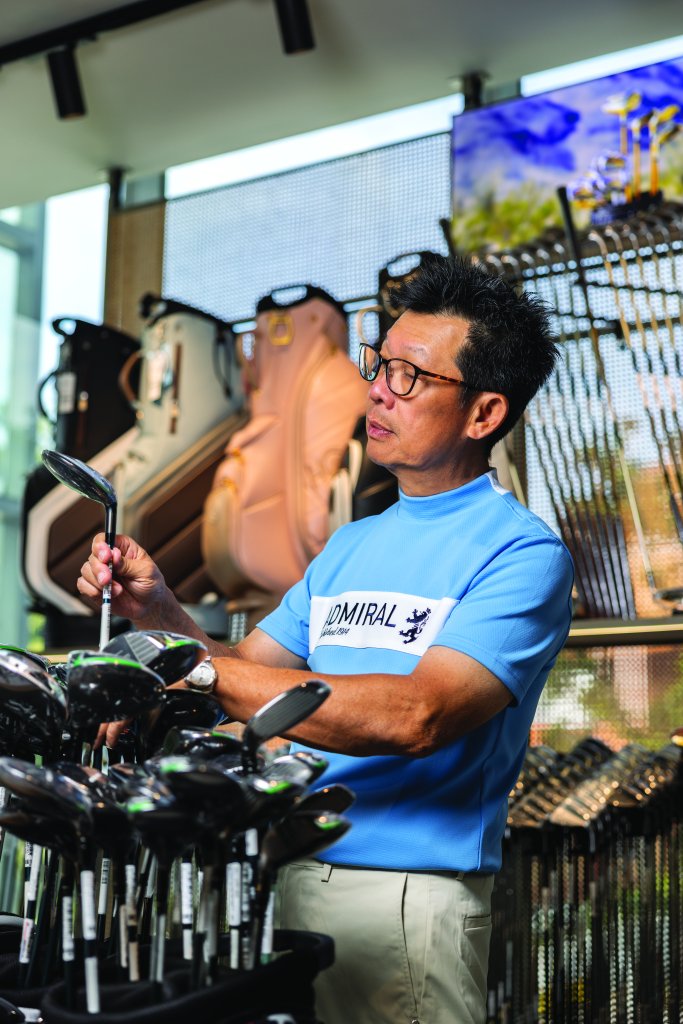
The solution was to expand into standalone retail environments, including locations such as IMM in Jurong and, most notably, a flagship store at The Cathay. “The idea was to create a space that showcases all our offerings,” Lee says. “Not just for country club members, but also for golfers who aren’t members.”
The Cathay store represents a departure from conventional golf retail design.
“In the past, you tried to cram as many products as possible into the space,” he says. “Here, we wanted people to stay longer.” The layout is intentional—grouping products by category rather than brand, creating open spaces, and incorporating design elements that evoke the golf environment.
“We even designed the pathway like a buggy track,” Lee notes. “We want people to feel something different.”
Sustainability was also a consideration. “We used more environmentally friendly materials, and we made use of natural light,” he adds.
Beyond aesthetics, the store is designed as an experiential hub. “It’s not just about coming in, buying something, and leaving,” Lee says. “We want people to spend time here.” This includes hosting networking events, small-group clinics, and interactive services such as on-demand golf ball printing.
“You can print a name or design on golf balls within one to two hours,” he explains. “It serves a market that wasn’t really served before.”
Technology also plays a role. A foot-scanning system helps customers find the best-fitting shoes, while data collection supports future personalisation. “No two feet are the same,” Lee says. “And the data can even be used for future purchases.”
The integration of data into retail operations is still evolving. “We launched a loyalty programme about nine months ago,” Lee says. “We have reasonable numbers, but there’s still more work to do.”
The goal is to build a system that tracks customer preferences and purchase history—enabling more targeted engagement. “For example, a customer might want to know what equipment they bought last year,” he says. “We should be able to provide that.” E-commerce has also been introduced, though Lee is realistic about its role. “Golfers still like to come to the shop to touch and feel,” he says. “For higher-value items, they want to try before they buy.”
GROWTH AND DIVERSIFICATION
As for the future, Lee sees both opportunity and uncertainty. “If the golf industry continues to grow, we’ll see more retailers,” he says. “If it stagnates, we may need to look at expanding into related products—or even other sports.”
With a parent company involved in multi-sport retail, diversification is a natural consideration. “We don’t know yet,” Lee says. “But it’s something for the future.”
Within golf, he believes there is still room for innovation—particularly in integrating retail more seamlessly into the customer journey. “In some countries, the retail space is part of the check-in process,” he notes. “It encourages people to walk through.” Such concepts would require significant investment, but Lee sees long-term value. “It has to be a partnership,” he says. “You can’t invest and then lose the contract in two years.”
A CAREER NEARING FULL CIRCLE
At 67, the youthful Lee is candid about his stage in life. “As long as the company feels I can still contribute, I’ll be happy to continue,” he says. “But I’d also appreciate the chance to take a back seat eventually.”
There is a quiet pragmatism in his outlook—an understanding that careers, like golf games, have their arcs. “Maybe it’s time to tone down,” he says. “Play more golf, spend time with my grandchild.”
It is a fitting image: a man who found golf almost by accident, built a career around it, and now looks forward to returning to it on his own terms. Steven Lee’s story is not one of sudden breakthroughs or headline-grabbing disruption. It is, instead, a study in longevity – of adapting to change, maintaining relevance, and staying connected to a passion over decades.
From VCR swing analysis in the 1990s to data- driven retail and experiential flagship stores today, his journey mirrors the evolution of golf itself.